
What a Week with Dr. Elkhonon Goldberg Taught Me About the Brain Behind the Charge
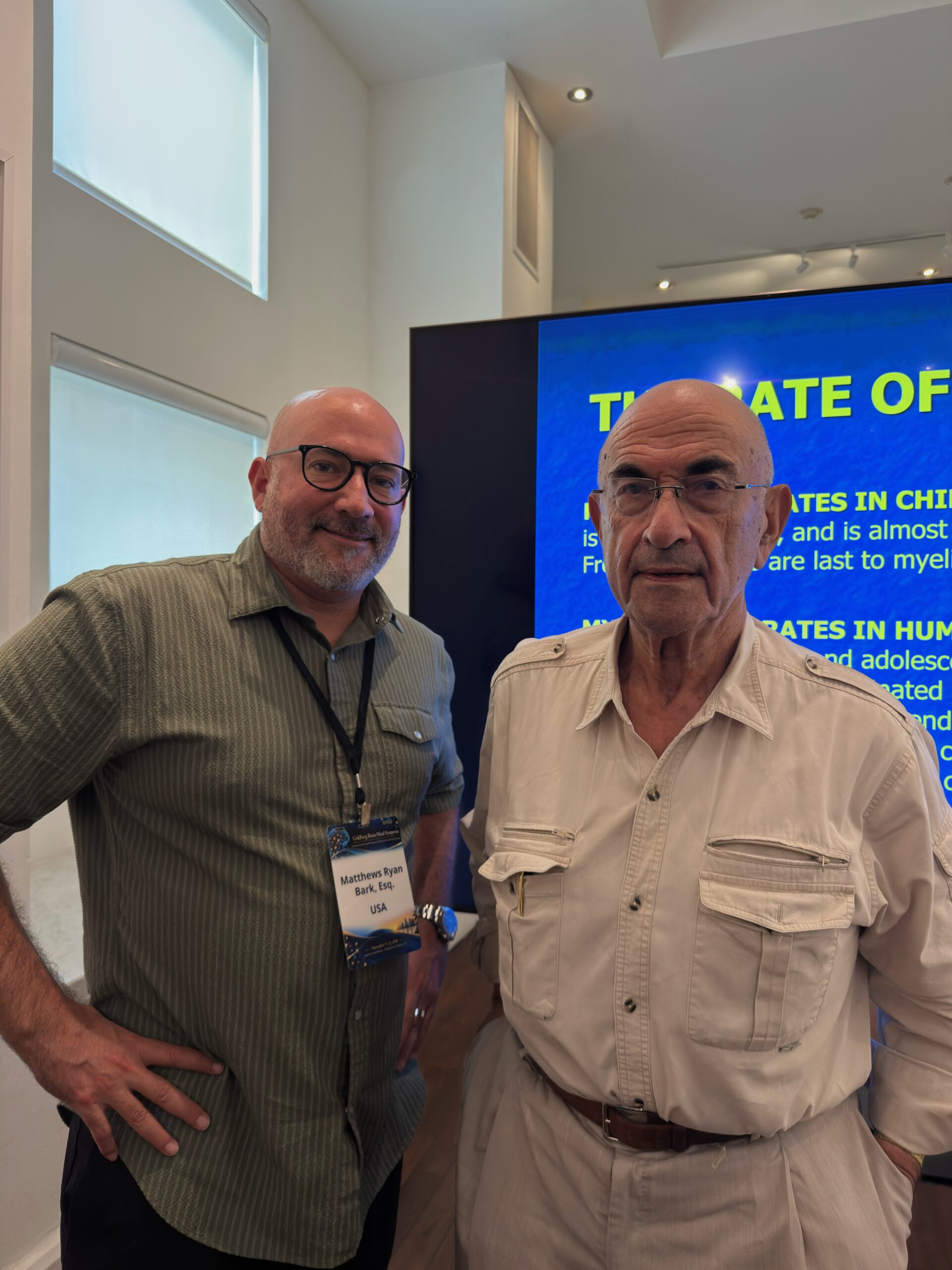
In November 2026 I spent three days in South Miami Beach at a continuing education program for psychologists and neuropsychologists, "Executive Functions and Dysfunction in Brain Health and Brain Disorders." It was taught by Dr. Elkhonon Goldberg, one of the world's leading authorities on the frontal lobes. I was likely the only criminal defense lawyer in the room.
I went because so many of the people I defend are not who the police report makes them out to be. A charge describes an act. It rarely explains the brain behind the act. More and more of my practice involves clients whose behavior is shaped by a developmental condition, a brain injury, or a dementia that no one has diagnosed yet. To defend those clients well, I need to understand the science as well as the experts who testify about it.
The brain's chief executive
"Executive functions" are the mental abilities that let a person set a goal, plan the steps, stay on task, shift course when things change, control impulses, and foresee consequences. Dr. Goldberg compares the prefrontal cortex to an orchestra conductor or a company's CEO. It does not play any one instrument. It coordinates all of them.
The conductor: what the frontal lobes coordinate
The prefrontal cortex does not do any one job. It directs the abilities that complex decisions depend on.
When that system is damaged or underdeveloped, a person can still talk, remember, and score reasonably well on many tests. What breaks down is judgment: planning, flexibility, impulse control, and insight into how others see them. From the outside, that can look like defiance, dishonesty, or a lack of remorse. In a courtroom, those are exactly the traits that drive charging decisions, bond, and sentencing.
One idea from the course stays with me. Modern neuroscience no longer thinks of the brain as a set of separate parts, each with one job. It thinks in networks. The frontal lobes are connected to nearly every other system in the brain, which is part of why they are so vulnerable to injury, illness, and aging.
The frontal lobes are the last to grow up
The frontal lobes are among the last parts of the brain to mature. By some measures their development runs past age 18, into the late 20s or early 30s. Dr. Goldberg pointed out that these ages roughly track the points at which societies, ancient and modern, grant people adult legal and social responsibility.
The rate of myelination
Myelin is the insulation on the brain's wiring. Humans start with almost none and finish late. The frontal pathways are the last to be wired.
The point matters for young clients. An 18- or 20-year-old is an adult under the law. The part of the brain that weighs consequences and restrains impulses is often still developing. That does not excuse a crime. It does help explain one, and it belongs in front of a prosecutor deciding what to offer and a judge deciding what sentence fits.
The same lobes are also among the first to decline with normal aging. Both ends of life are where frontal-lobe science tends to come up most in my cases.
When a brain change looks like a crime
Dr. Goldberg described a pattern that neuropsychologists have long called "pseudopsychopathic." Damage to the orbitofrontal region, the underside of the frontal lobes, can produce poor impulse control, emotional volatility, an inability to delay gratification, and general disinhibition. The person may be at real risk of antisocial behavior. The cause is often a traumatic brain injury, a stroke, or a degenerative disease.
He also drew a distinction I expect to use. Impulsive misconduct is linked to damage in the orbitofrontal cortex. Calculated deception, by contrast, depends on frontal regions that are working. That line is useful to the defense and to the State, and any lawyer raising a brain-based defense has to be ready for both sides of it.
Impulsive misconduct vs. calculated deception
The same act can come from a damaged brain or a working one. The science helps tell them apart.
Orbitofrontal damage
The "pseudopsychopathic" syndrome. Often caused by TBI, stroke, or dementia such as FTD.
Working frontal regions
Deceptive behavior is linked to activation, not damage, of frontal areas.
The course materials on dementia were striking:
- A nationwide Finnish registry study of more than 92,000 patients found that new criminal behavior often appeared years before a dementia diagnosis, on average about 2.7 years. Most offenses were traffic and property crimes. Frontotemporal dementia carried the highest rate (Talaslahti et al., American Journal of Geriatric Psychiatry, 2020).
- A University of California, San Francisco study found that 37.4% of patients with behavioral-variant frontotemporal dementia had criminal behavior emerge during their illness (Liljegren et al., JAMA Neurology, 2015).
- Vietnam veterans with injuries to the ventromedial frontal cortex were rated more aggressive and violent than other veterans (Grafman et al., Neurology, 1996).
The arrest can come before the diagnosis
In a nationwide Finnish study, the first offense came an average of 2.7 years before anyone diagnosed the dementia.
64 of 171 patients with behavioral-variant FTD at UCSF had criminal behavior that first emerged during their illness.
The lesson for families is direct. When a person with no record is suddenly arrested in their 60s or 70s for shoplifting, a traffic offense, or an out-of-character outburst, the first question should not only be "what did they do?" It should also be "what is happening to their brain?"
A diagnosis is not the end of the inquiry
Dr. Goldberg is known for challenging received wisdom, and he did so throughout the course. He was blunt that ADHD is often diagnosed casually, by people not qualified to make the call. He argued that some children labeled hyperactive have something else entirely, and that several conditions, including Tourette syndrome, are frequently misidentified.
He also drew a distinction that every trial lawyer should know. A disease is defined by its cause and usually has clear boundaries. A syndrome is a cluster of symptoms that tend to appear together, and its edges are often blurry. Many psychiatric and neurodevelopmental diagnoses are syndromes. As he put it, that makes diagnoses more subjective and arbitrary than most people assume.
Diseases vs. syndromes
One has a clear edge. The other shades into everything around it.
Disease
Defined by cause. Often discrete, with clear boundaries.
Syndrome
Defined by symptoms that tend to occur together. Dimensional, with blurry edges.
That cuts both ways in court. A diagnosis can open the door to mitigation, competency questions, or a defense. It can also be overstated, by either side. Testing tools have limits too, and standard intelligence tests may not measure executive function well at all. A client with a normal IQ score can still have serious frontal-lobe impairment. The defense needs an expert who understands those limits, and a lawyer who knows enough to test the State's expert on them.
Working with Dr. Goldberg in my own cases
This course was not my first time learning from Dr. Goldberg. I have retained him as a defense expert in two of my cases. In both, his evaluation gave the court and the prosecution something they had not seen before: a clear, science-based account of how my client's brain actually worked, and why that mattered to what happened. In both cases, his work helped us reach remarkable results for my clients.
What sets him apart as an expert is the same thing that sets him apart as a teacher. He explains complicated science in plain language, he does not overstate it, and he is willing to say when the conventional view is wrong. Judges and prosecutors notice that.
Every case is subject to its own facts and circumstances. Past results do not guarantee the same or a similar outcome in any other case.
What this means if someone you love has been charged
If you are a family member reading this, a few practical points:
- Tell your lawyer about any history. Head injuries, concussions, strokes, developmental diagnoses, memory problems, or recent personality changes all matter. Families often know about them long before any doctor does.
- Do not assume the change is "just aging" or "just bad behavior." A sudden shift in judgment, impulse control, or social behavior can be an early sign of a brain disorder.
- Get the right evaluation. A general mental health screening is not the same as a neuropsychological evaluation focused on executive function. The right expert can make the difference.
- Act early. Evidence of a condition is most useful before plea negotiations harden and before a case is set for trial.
At Bark Law, I represent people charged with crimes in Seminole County, Orange County, Volusia County, and throughout Central Florida, with a particular focus on clients who are neurodivergent or living with brain injury, dementia, or other cognitive conditions. If someone you care about is facing charges and something about their behavior does not add up, call my office.
Call 407-865-8888